A personal note for ex-Opaly users
Opaly is now GrantForge.
And we listened.
You used Opaly in 2025 — for six months, then it stopped. Here is what we rebuilt because of your feedback, and the nine things that were not there before.
Early adopter program — full access, no card, no clock. Sign in with your email.
The deal-breakers
You said it. We fixed it.
The three things you said out loud in our discovery calls. The three things we prioritised first.
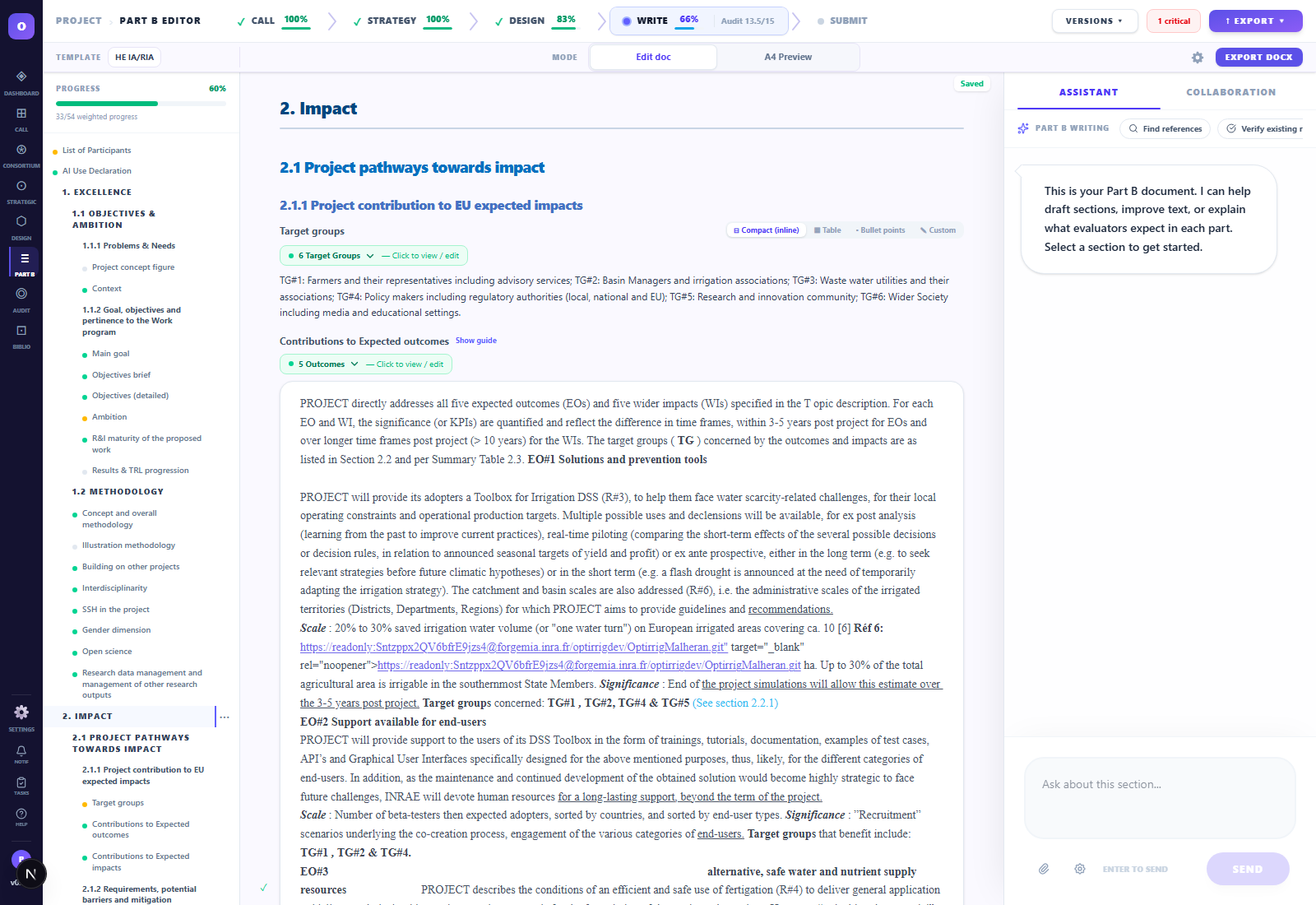
Import fidelity was the deal-breaker.
“You spent more time cleaning up imports than copy-pasting manually.”
High-fidelity import preserves sections, formatting, references and figures. A colored diff shows you exactly what landed where.
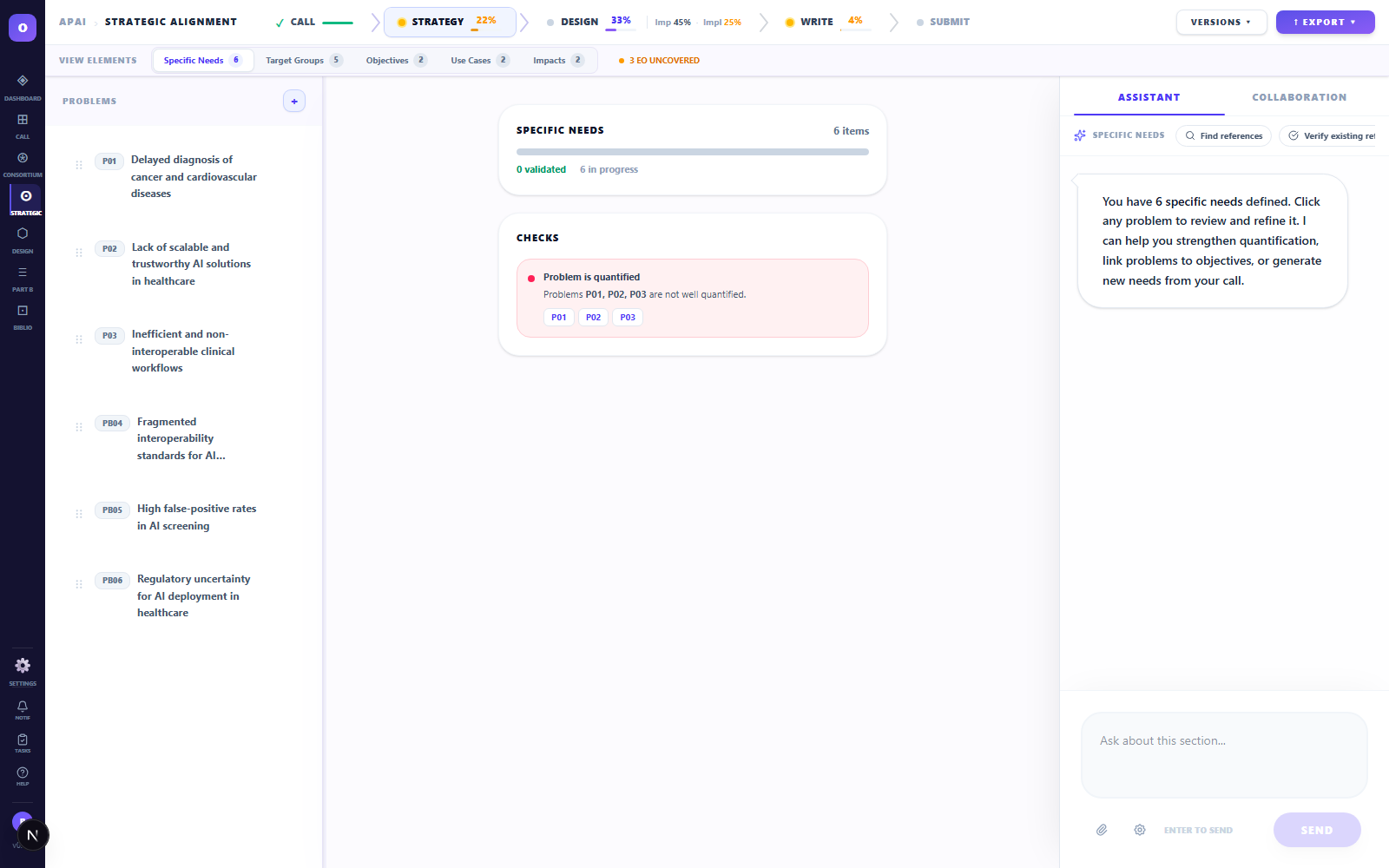
You were tired of being your partners’ mailbox.
“Half your time went into chasing partners, consolidating their Word docs, and re-formatting them into your draft.”
Drop a partner Word doc into the project. The assistant reads it, identifies which sections it relates to, and proposes edits as a reviewable diff.
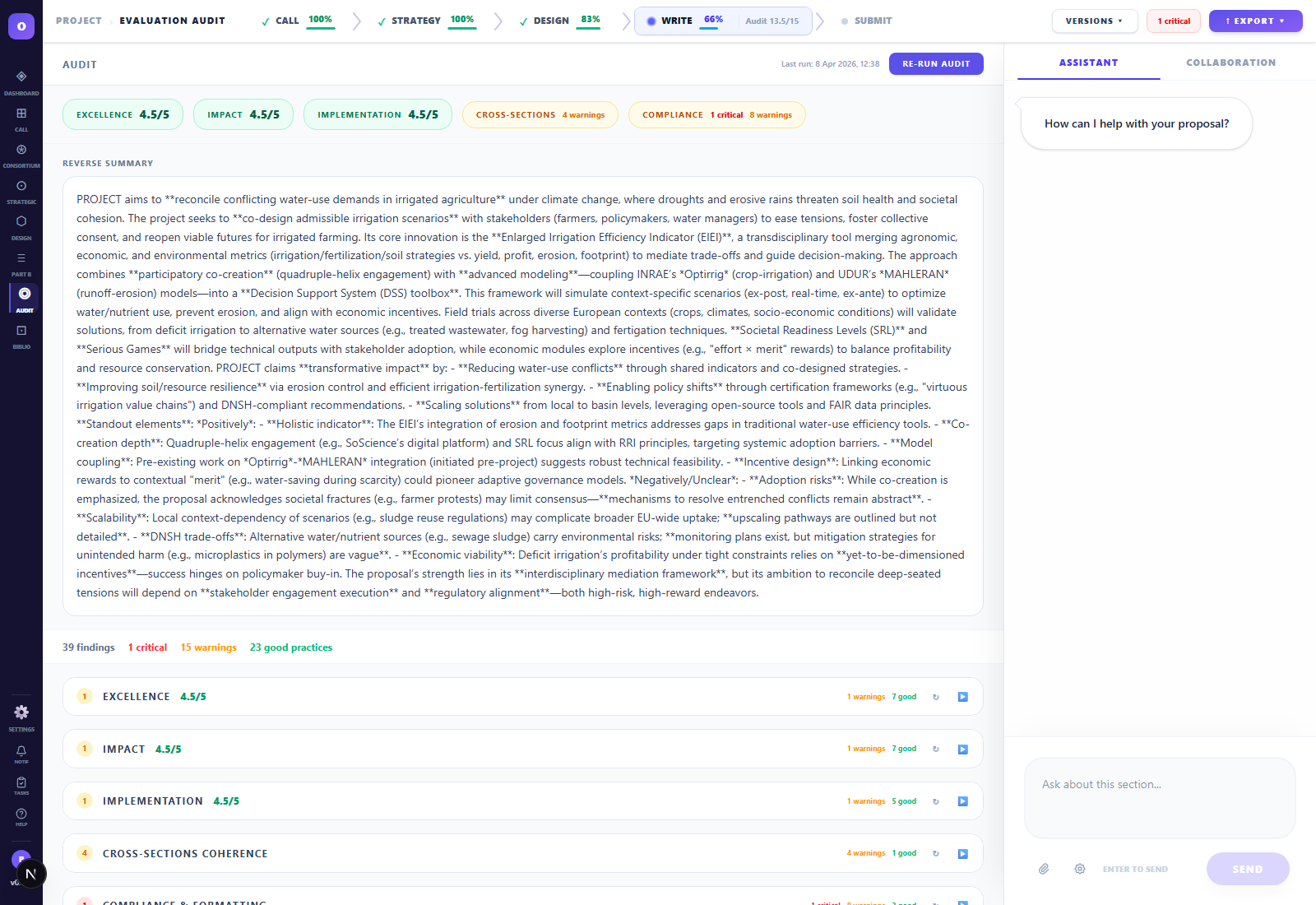
You wanted an evaluator pass before submission.
“It is always frustrating to find out, after submission, that you forgot to update the Gantt chart, the deliverables table, or a milestone.”
One audit pass scores Excellence, Impact and Implementation, checks coherence across sections, and flags compliance issues.
The deal-breaker, solved
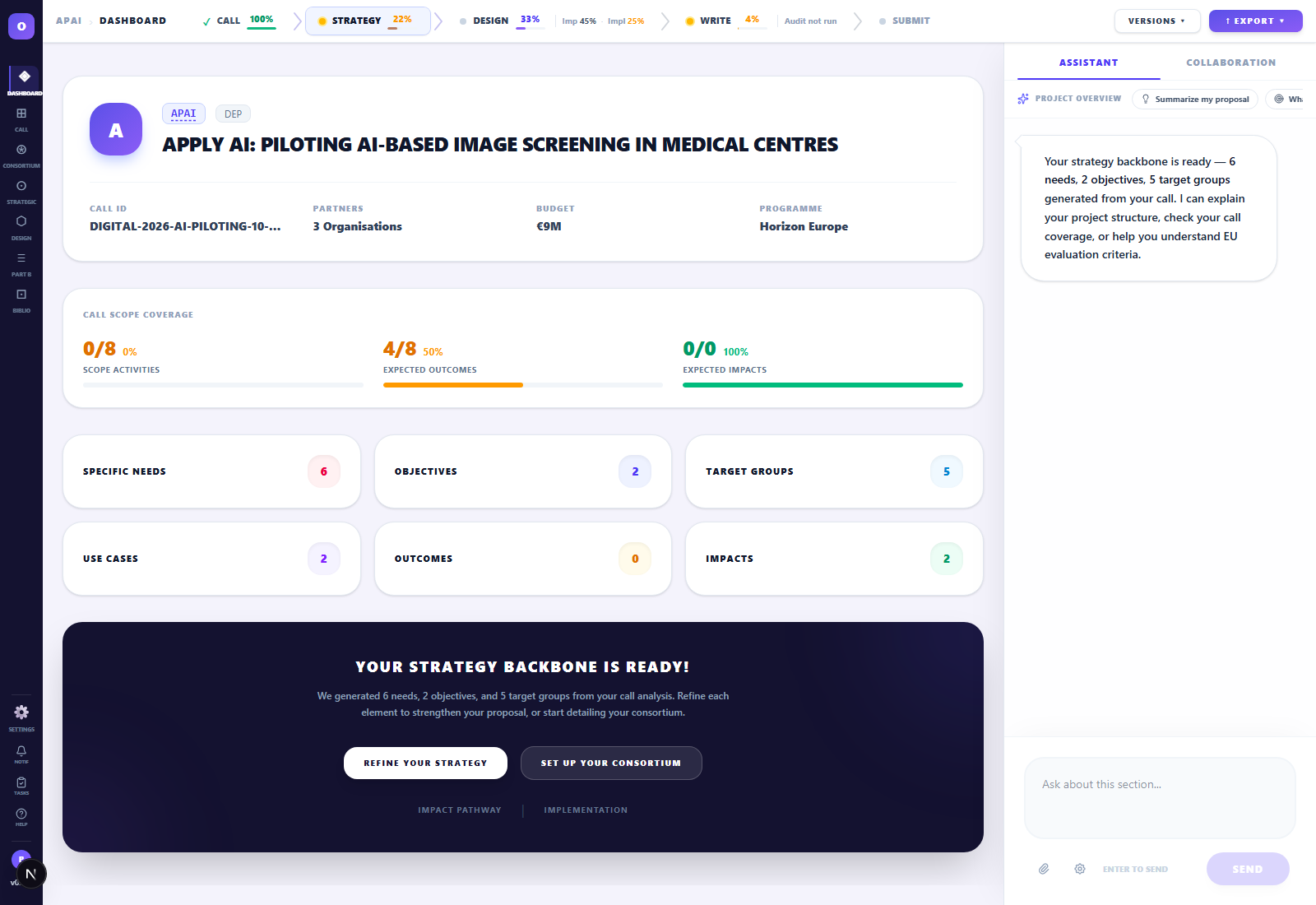
See a real proposal imported, section by section.
Drop a Part B PDF. GrantForge parses it semantically, preserves the formatting, and lays everything out the way the EU template expects. No cleanup hours.
What is new
Nine things that were not there before.
Each one is shipped, live, and ready to test today.
Drop your old Part B, keep the formatting
Import a submitted proposal as a PDF and get a clean, editable project with references, tables, and styling intact.
“You told us fidelity on import was non-negotiable. So we rebuilt it.”
An evaluator reads your proposal before the reviewers do
One pass that scores Excellence, Impact and Implementation, checks coherence across sections, and flags compliance issues.
“You said the worst moment is finding a mismatch after submission.”
Stop being your partners’ mailbox
Drop partner Word contributions into the project. The assistant reads them and proposes reviewable edits as a diff.
“You said chasing and consolidating partner text eats your week.”
A guided path researchers actually finish
A phase-by-phase walkthrough from scoping to submission, with a live coverage dashboard so nothing is left half-written.
“You said your researchers opened the app once, got lost, and went back to Word.”
Your references, entered once, clean everywhere
Paste DOIs, PMIDs or OpenAlex results — every citation comes out consistent across Part B, footnotes, and bibliography.
“You said retyping references between sources and sections was the silent time-sink.”
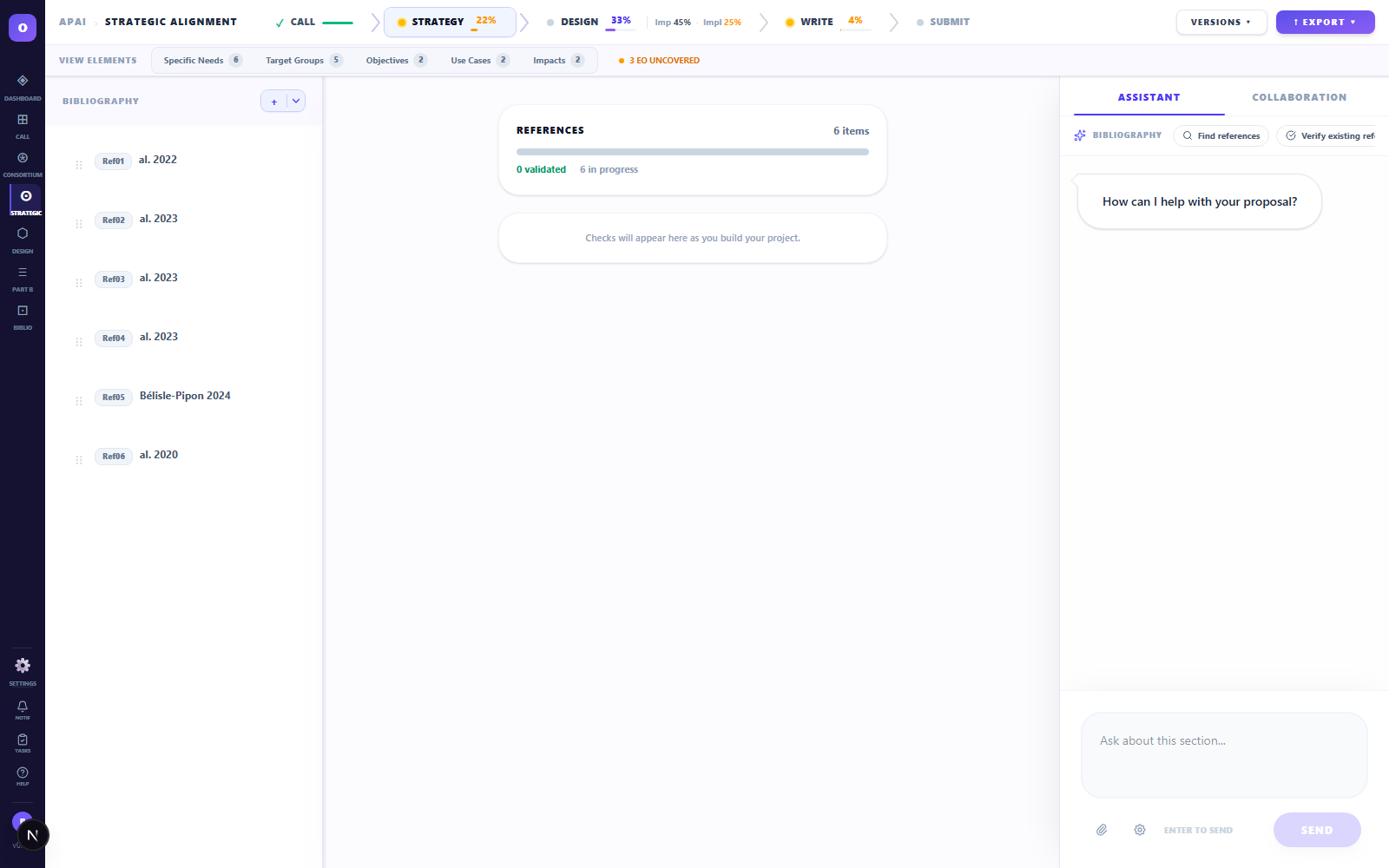
Every open call, with a page you can bookmark
Browse Horizon Europe, DEP, LIFE and growing national calls. Each call gets a shareable analysis page you can bookmark for your team.
“You said call intelligence lives in fifteen tabs and one Excel.”
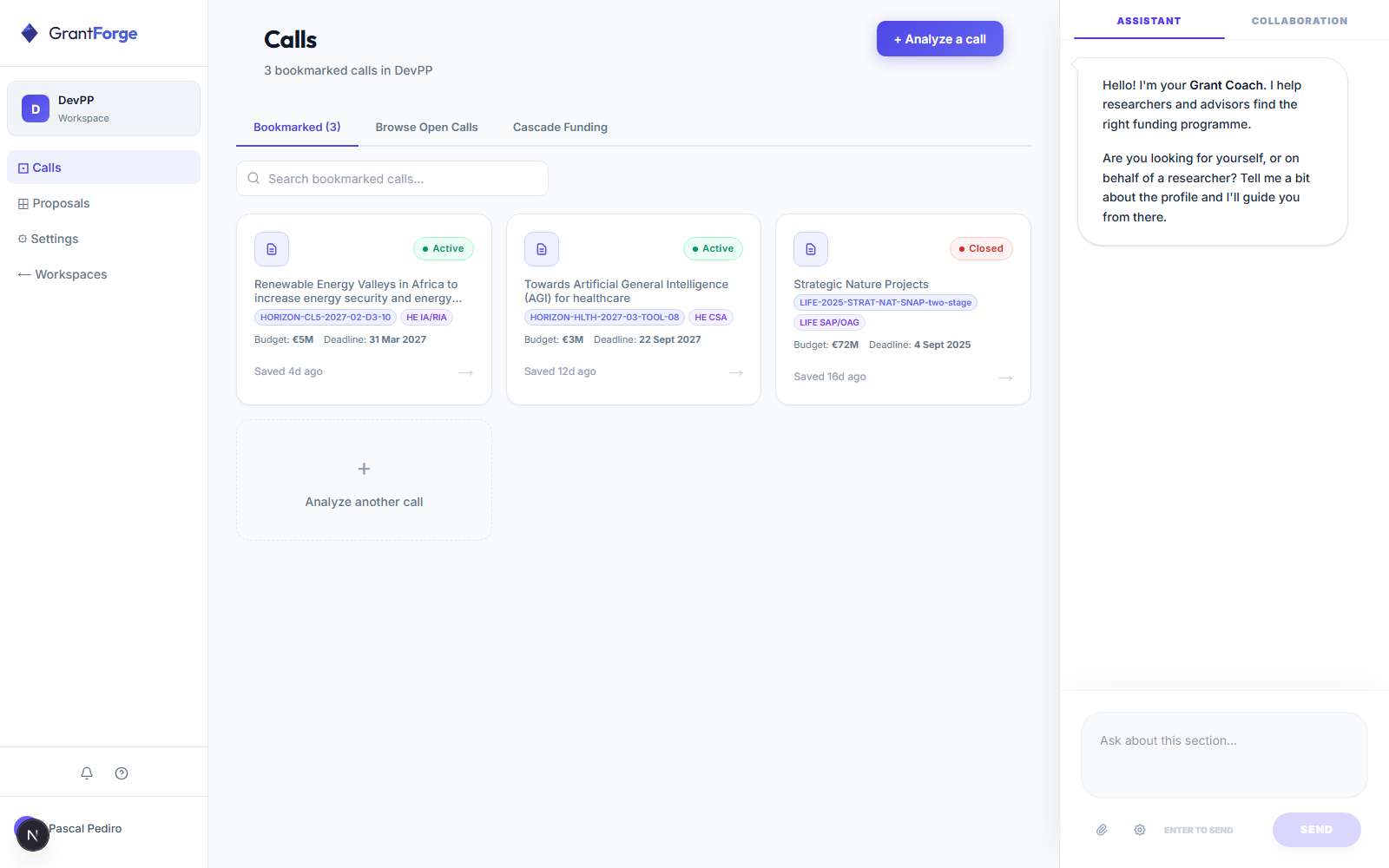
Eighteen programme templates, ready on day one
Horizon Europe IA / RIA / CSA, EIC Pathfinder, EIC Transition, WIDERA, JU programmes (CleanH2, Chips, EU-Rail, CBE), DEP, LIFE, Eurostars 3, NWO NWA-ORC, ANR AAPG.
“You said Opaly only covered a sliver of the programmes you actually write.”
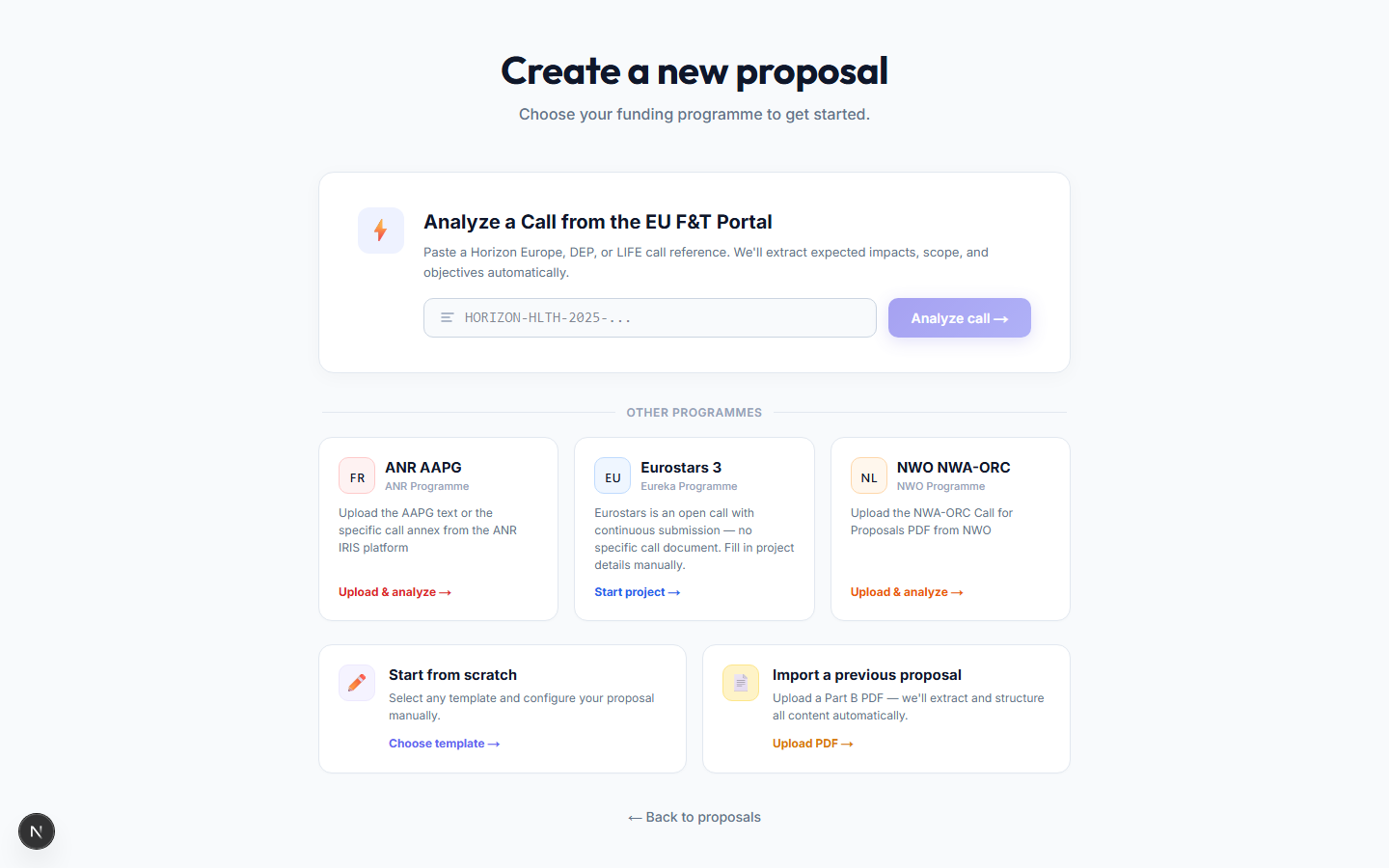
Exports that look like your institution
Per-project templates, custom fields, headers, footers and cover pages so the DOCX you send is submission-ready.
“You said the last mile — styling the export — cost you a full day.”
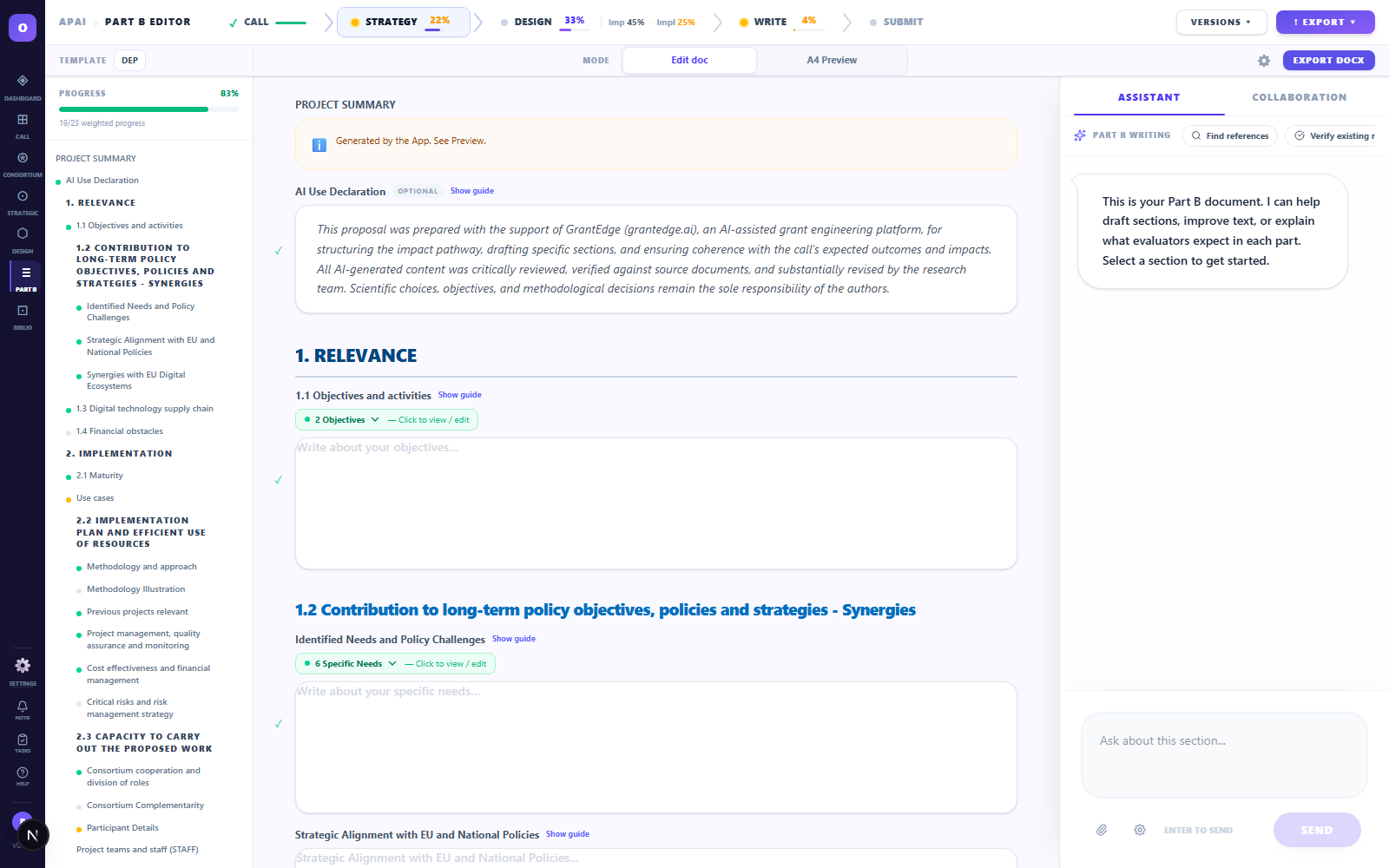
A coach for the EU funding landscape
A dedicated assistant that explains Horizon, DEP, LIFE and national programmes in plain language and helps junior colleagues map their topic to the right call.
“You said new joiners struggle to navigate the EU funding landscape alone.”
Deep dive — the evaluator pass
An evaluator reads your proposal, before the reviewers do.
The Audit is a single pass written to mimic an EU evaluator: it reads each section, checks that the strategic backbone, the impact pathway, and the implementation hold together, verifies that elements named in one section actually exist in the others, and finally runs the compliance checklist (page limit, keyword density, mandatory sections, ethics, gender, open science).
You get scores for Excellence, Impact and Implementation, plus a structured list of findings with severity badges. From the second run onward, every finding is marked New / Resolved / Worsened so you know what changed since your last pass.
- Section-level evaluation — Excellence, Impact, Implementation
- Cross-section coherence — references match definitions, no orphans
- Compliance — page limit, mandatory sections, keywords, ethics, gender, open science
- Streamed findings with severity badges and run-to-run change tracking
“A French research office told us they used to find a Gantt-vs-deliverable mismatch after submission. Not anymore.”
See it on your project →The differentiator
A Project AI Assistant that knows your proposal.
Every GrantForge project comes with the Project Copilot — a context-aware AI assistant that lives on the right side of every view. It has read your call analysis, your strategic backbone, your Part B sections, your consortium and your bibliography. It does not invent — it reasons over what you already have.
It can do the boring work for you: generate Specific Needs from a call, propose KPIs for an Outcome, draft a Part B section, or audit a single element against the evaluator criteria.
And — the killer use case — drop a partner’s Word doc into the project. The Copilot reads it, identifies which sections it relates to, and proposes edits as a diff you can review and accept.
“One coordinator told us half their time was spent chasing partner contributions and consolidating Word docs. The Copilot does the consolidation. They get their week back.”
Try the Copilot live →Built in the EU — and that matters
Your proposals are confidential. We treat them that way.
Some of your IT security and privacy officers noticed that, despite European hosting, certain underlying cloud providers were US-based. While GDPR was respected, we understood the uncertainty raised by the current US regulatory context — and removed those dependencies. GrantForge now runs on a dedicated European infrastructure hosted in Germany, so you can confidently bring this to your CISO or DPO.
EU compute, EU AI provider
GrantForge runs on Hetzner (Nuremberg, Germany). The default LLM provider is Mistral — also EU. We are completing the migration of all data services to fully EU-hosted infrastructure, with self-hosted Supabase available as an Organization add-on for institutions with the strictest data-residency policies.
Private buckets, signed URLs
Every proposal lives in a private storage bucket protected by row-level security. Files are only ever served via short-lived signed URLs. No public links by default. We do not train any model on your content.
Archive or delete, anytime
You can archive a project to hide it from your workspace, or hard-delete it to wipe everything — the strategic backbone, the Part B sections, the bibliography, the partner data. Archival and deletion are first-class actions, not buried in support tickets.
If your institution has a CISO or DPO with specific requirements, book a 20-min call — I will walk you through the architecture and the data-flow diagram.
Pick your path back.
You have used Opaly. You know the territory. Here are two ways to come back.
Self-serve
Join the early adopter program
Sign in with your email and get full access — no card, no clock. Create a project, import a Part B, run an audit, export the DOCX. Twenty minutes from sign-up to your first generated section.
Get full access →High-touch
Book 20 min with Pascal
I will walk you through GrantForge with one of your real proposals. We will import a Part B together, run an audit, and you decide if it fits your team.
Book 20 min with Pascal →The questions you are about to ask.
If your question is not here, just reply to my email or book a call.
How much does it cost right now?+
Right now: nothing. GrantForge is in an early adopter program — full access, no card, no clock. The whole point of these few weeks is to give ex-Opaly users and a handful of new teams the time to actually use the app on a real proposal and tell us what works and what does not.
And later? When does pricing kick in?+
Paid plans roll out in June. There will be a self-service tier for individual researchers, a per-project option for teams that prefer one-shot pricing, and a team / institution plan for pre-grant support offices and cabinets. Final pricing is shaped with the early adopters — if you are in the program, you have a say in how it lands.
What happens to my old Opaly projects?+
Opaly is sunset. There is no automatic migration — but you can import any Part B you exported (or any Word/PDF version of an old proposal) into a new GrantForge project in a few minutes via our high-fidelity import. If you need help with a specific Opaly project, book a 20-min slot with me and we will do the import live together.
Where is my data stored?+
GrantForge compute runs on Hetzner (Nuremberg, Germany). The default LLM provider is Mistral — also EU. Project files live in private storage buckets protected by row-level security and only served via short-lived signed URLs. We are completing the migration of all data services to fully EU-hosted infrastructure; for institutions with the strictest data-residency policies, self-hosted Supabase is available as an Organization add-on. We do not train any model on your data.
What languages does GrantForge support?+
The product UI is English, and the Copilot, the Part B writer agents and the import pipeline all work in English. Most EU calls are in English anyway. If you need French or another language for specific sections, just ping me.
Can I migrate from Word workflows progressively?+
Yes — that is the most common path. Many power users start by using GrantForge as a quality checker on Word drafts: run an audit, fix the findings, go back to Word. The full collaborative writing experience is opt-in, not forced.
Ready when you are.
You used Opaly. You know what worked and what did not. Come see what we did with your feedback.